By Gwen Hoogendoorn, Board President-Ohio Wildlife Rehabilitators Association
While licensed wildlife rehabilitators encourage people to “put the baby back” there are instances where this is either not practical or the animal may require medical intervention. Here are a few instances where putting the baby back is in the best interest of the animal and what YOU can do to facilitate a successful reunion with parents or help determine if additional assistance is needed.
Fawns:
Did you know that momma deer will often favor your landscape, bushes or lawn to have her baby? For the most part, your lawn is safer than the woods. It doesn’t seem intuitive but, they will even have their fawns in the shrubs of local businesses! Fawns are often mistaken as “abandoned” but, mom only visits them a few times in a 24-hour period, then goes away. Fawns are born with very little scent, instinctively lay motionless for hours and have amazing camouflage. These special adaptations are all strategies to not draw the attention of predators.
How can you help? Put the Baby Back… and leave the area. Keep children and dogs away! Fight the urge to “keep checking.” Mom will not return if she sees you/your pets near her little one.
Is the fawn in trouble? Do you see an injury or blood? Diarrhea? Flies? Severely curled tips of the ears? Is it crying and approaching you? Is it near a deceased mom?
Here’s what you can do: Please be quiet around the fawn. Your soothing touch and voice are calming to your domestic pets but are scary and strange to wildlife.
PLEASE DO NOT feed the fawn. When well-intentioned people feed inappropriate food (often due to unreliable info on the internet) fawns develop diarrhea. A mother deer will not accept “sick” babies. In Ohio, there is a 72-hour law imposed on fawns by the Division of Wildlife. A wildlife rehabilitator has 72 hours to provide appropriate care and then either reunite the fawn with mom or find a suitable foster with a similarly sized fawn. The clock is ticking and diarrhea in a baby lessens a rehabilitator’s chance to help the fawn return safely.
Bunnies:
Momma bunny took a lesson from mom deer. She often has her babies in your yard. She, too, will only visit a few times in a 24-hour period and then go away. Her babies lay still until her return.
How can you help? Put the Baby Back… and leave the area. Keep children and pets away. Fight the urge to handle and “keep checking.” Mom will not come back if she sees you/your pets near her little ones. Do you have a cat or dog? Until the babies are a few weeks old, please take your dog out on a leash. It’s inconvenient for sure but it’s only for a short time until the bunnies are old enough. At 3-4 weeks they are considered “adults.”
Kitty cat? We all LOVE our fabulous felines, but they wreak havoc on wildlife, especially babies. Please consider keeping kitty in the house. This is safe for kitty too! If the nesting material was disturbed but the bunnies are fine, replace the nesting material back over them.
If you are not sure if mom is returning, place flour around the nest OR place rope in a hash pattern over the nest (please don’t use thread since they can become tangled). If rope or flour is disrupted in the morning, momma has most likely been there. There are several other options to help protect them while they grow. For more information, reach out to your local wildlife rehabilitator for ideas!
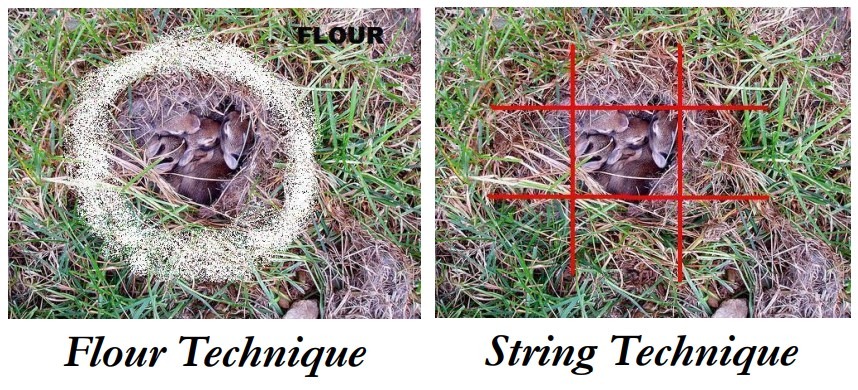
Two simple methods to determine if a mother rabbit is visiting her nest: sprinkle flour around the nest (left) or lay string in a hash pattern over it (right). If disturbed by morning, mom has likely returned.
Is the bunny in trouble? Did your cat or dog bite them/mom. Were they accidentally run over by a lawn mower? Was the yard flooded and the bunny is cold?
Here’s what you can do: Place grass, nesting material or a towel in a small box or tub (with sufficient air holes). You can use a rice sock, warm water bottle or heat pad to keep the babies warm. If using a heat pad, place the box on half of the pad so the babies can move away from the heat if they get too hot. Put the box/tub in a QUIET, DARK place.
Did you know that bunnies suffer from acute stress? Their natural history is to “flee” or “freeze”. People mistake them for being “friendly” because they are not trying to escape. This behavior is not because they like us, it’s associated with stress and fright, so they freeze in place. What is happening is that their cortisol levels surge ~ 10 to 20x higher than normal. This is life threatening!! If their levels stay too high, even for a short period of time, it suppresses their immune system and they can easily die even days later. Stay quiet, don’t pass them around for people to touch and see, drive them to your local wildlife rehabilitator (no radio or cell talking please). They will thank you later.
Raccoons:
Did you know mom usually has her babies in March and sometimes a second litter in July? During this time, you may see her on the move, even in daylight. She is doing “mom” things like getting herself food and water while the little ones are sleeping. All moms (human or otherwise) are familiar with this! Having babies has high energy/calorie demands on mom so she will forage even during the day. She will also be scouting for alternate den sites in case her current house is disturbed. Raccoons are highly intelligent (which is why they get into so much trouble). They quickly realize that humans = food but this can have severe consequences for everyone.
How can you help? Put the Baby Back… and monitor. Young raccoons learn to forage with mom but sometimes get left behind if she gets scared and runs. Sometimes they climb into dumpsters and garbage cans with her but are not big enough to get back out. Raccoon moms are very dedicated to their young and will come back for them. You can use a thick pair of gloves and a heavy towel to get the baby out of a trash can or just gently tip it over. If it is in a dumpster, place a wide board for the raccoon to climb out. Most of the time, they understand what to do.
Is the raccoon kit in trouble? Is it injured? Does it appear sick? Crusty eyes, dehydrated and cold? Is it running up to you, following you and crying for food?
Here’s what you can do: IMPORTANT!!!! PUT GLOVES ON!!! DO NOT BARE-HAND A BABY RACCOON. The Ohio Department of Health often requires the rehabilitator to euthanize the baby because you were scratched or nipped. This is called an “exposure.” The rehabilitator must legally report this to the local health department because your safety comes first. Secure the baby in tote or box with a towel and airholes. DO NOT pass the baby around for photo opportunities or let your pets or children near it. It’s cute for sure but this puts everyone, including the baby you are trying to help, in a very bad situation, especially after being showcased on social media. Put the little raccoon in a quiet, dark area. Call a wildlife rehabilitator.
Raccoon rehab can be tricky at times:
- They may ask you to attempt a reunite if you/they suspect mom is still alive. This entails taking the raccoon back outside in an open tote, upside down laundry basket or cardboard box (provided it’s not raining and the baby can stay dry). Provide a heat source such as a warm water bottle or heat disk. It is important that the baby stay warm during this process. Place the animal back where you found it as long as it’s safe. If mom is around, she will hear the cries and remove it from the container.
- If the baby is truly an orphan, this can be challenging sometimes since rehabilitators fill up quickly. Rehabbers cannot take unlimited numbers due to capacity, resource availability and legal minimum standards/limits. Raccoons come with special requirements that other mammals don’t necessarily have, to include longer, mandatory quarantine times. Some rehabbers cannot accept raccoons based on the category of their permit. This is why attempting reunites with original mom is critical. While Raccoon moms are dedicated to their kits, they are not fond of others. Also, some counties are considered “hot.” This means that the Division of Wildlife considers the risk too high for raccoon rehabilitation, so rehabilitators are not permitted to accept them except for euthanasia. It’s frustrating but please do not be angry with the rehabilitator for following the laws. Contact the Division of Wildlife to find out if your county is a “hot” county if you are unsure or ask your local wildlife rehabilitator. If your local rehabilitator is able to legally accept them and has room, they will.
- Did you know there is a nuisance wildlife law in Ohio? Among other things, if you hire a commercial nuisance operator to remove an adult raccoon or you illegally relocate the mother and realize afterward she had babies, wildlife rehabilitators are not permitted to help those babies and by state law they too must be euthanized. This is true for all wildlife in Ohio. Rehabilitators are not in the business of killing animals because the parents were deemed a nuisance so they may refuse to accept the orphans and require you to contact that commercial nuisance operator to take the babies. Please be aware, commercial operators are required by state law to kill raccoons, and various other species, that are removed from your property.
Please consider utilizing a (certified) non-lethal operator who will evict and/or humanely deter them from your property versus killing. Please note: these must advertise NON-LETHAL. You may also find solutions for mitigation in several humane book sources such as “Wild Neighbors: The Humane Approach to Living with Wildlife.” These types of references can help you find ways to have the animal move on safely and provide instructions for barricading spaces so others don’t move back in.
Warning: Raccoons seem sweet and adorable as babies, but this does not last once they reach maturity. Their natural instinct (as well as birth right) is to be free and when the hormones kick in, that’s when trouble starts. It is illegal to raise wild animals as well as unsafe for you and ends very badly for the animal in the long run. They become destructive and potentially dangerous as well as confused and disadvantaged when raised incorrectly by humans. Respect wildlife. They want to remain WILD.
Below are some helpful resources:
How to contain and transport as well as tips and tricks for reuniting, getting help.
https://ohiowildlifecenter.org/safely-containing-and-transporting-wildlife/
Facts about wildlife babies and what to do.
https://ohiodnr.gov/discover-and-learn/safety-conservation/about-ODNR/wildlife/orphaned-injured/
Where to find a rehabilitator near you: OWRA will help you find a rehabber in Ohio near you. Animal Help Now is for locations across the US
https://www.owra.org/resources
–Gwen Hoogendoorn is the President of the Ohio Wildlife Rehabilitators Association Board of Directors. She has served over 20 years as a wildlife rehabilitator for the Ohio Wildlife Center, is a nationally certified responder for Oiled Wildlife Response and is a state and international wildlife educator.