
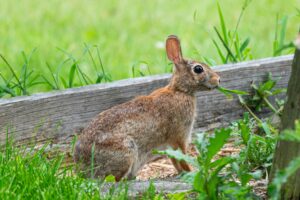
A curious cottontail rabbit pauses to munch fresh grass and dandelion greens alongside a rustic wooden fence on a sunny spring day.
Spring has sprung! And, more importantly, so has planting season. All of the foods that make summer and fall so enticing—apples, tomatoes, watermelons, and even pumpkins–are just over the horizon. But, as we prepare to plant all of our food, our local wildlife is getting hungry. In the springtime, babies are born, animals come out of hibernation, and, just like us, they want to spend more time in the warm sun. If you want to provide the best environment for our local wildlife while keeping your own produce safe, we’re here to help you out!
The most important thing to remember is that our home is also their home! A sign of a healthy garden often includes visits from local wildlife, like insects and pollinators, birds, and small mammals.
Keeping your produce safe
If you’re looking for a minimally invasive method to keep animals like mice, rabbits, and squirrels at bay, there are a variety of natural deterrents at your disposal.
According to Deidra Jacobsen, Assistant Professor and Conservatory Director at Miami University Hamilton, plants with strong odors and flavors can be effective safeguards for gardens.
“When plants are going to be defensive against insects or animals, it’s because they produce a lot of defensive compounds that make them unattractive,” Jacobsen said. “So, a lot of the spices and flavorings people use in their food or seek out are actually really repulsive to insects and animals.”
For example, alliums (onions, garlic, and the like), as well as lavender and sage, tend to ward off squirrels, rabbits, and even deer.
Jacobsen also noted that plants with capsaicin, like varieties of chili peppers, can work as well, although the chemical compounds in capsaicin can be harmful to small mammals like squirrels and rabbits, the same way they irritate our skin and eyes.
There is another natural method Jacobsen mentioned, although she emphasized it may not work for those with weak stomachs! Egg solids can be a natural deterrent when applied at the base of specific plants, particularly against deer.
Naturally, it smells terrible.
“I haven’t seen any environmentally negative effects of applying egg solids, but, as you might expect, it smells awful,” Jacobsen said. “If my entire garden smells like rotten eggs, I don’t care that the deer are in it, because I’m also not in it!”
If odors aren’t working, fencing can also be a successful tool. There are a variety of netting and fencing options that fit most garden needs. For in-ground gardens, it may be helpful to put fenceposts a few feet deeper if you have any burrowing mammals, like moles or gophers.
You can also use visual and audio aids like windchimes, or fake animals. It’s no wonder scarecrows have been a long-standing tradition amongst farmers!
Ways to create a garden for all
One of the biggest keys to a successful garden is biodiversity. Perhaps the easiest (and most cost effective!) way to increase native biodiversity in gardening is composting.
Composting involves taking food scraps, yard trimmings, and other organic waste and recycling it to create a healthy, diverse environment. The benefits are numerous!
According to the U.S. Environmental Protection Agency, there is up to a 78% reduction in greenhouse gas emissions when organic waste is recycled rather than taken to a landfill. In soil, composting leads to higher soil fertility, which in turn decreases weed and parasite growth, and increases crop yield.
Additionally, it provides a stable food source for worms and other insects, whose ingestion of compost helps to create a powerful, natural soil fertilizer.
The benefits of composting are not only endless, but also cyclical. One season of composting in a garden can culminate into years of healthy, diverse habitats alongside fresh, locally grown produce!
As always, be sure to consult a local wildlife specialist for more specific info on keeping animals safely at bay, or for questions on gardening practices. Now, get outside and get planting!