
By Zach Hagen
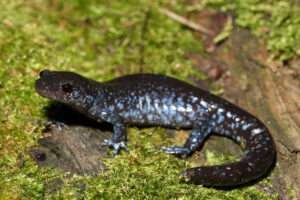
A blue-spotted salamander displays its striking bluish-black body and signature blue flecks while resting on a mossy forest floor.
Blue-spotted salamanders can be found in damp parts of deciduous hardwood forests and swampy woodlands, although they can also be found in coniferous forests and fields. As amphibians like to stay wet to keep their skin healthy, the blue-spotted salamanders tend to stay underground during the day. At night, however, they like to emerge from the soil to feed. During the warm season, they have been seen to venture out in the open during rainy days to keep their skin healthy. To ensure a safe environment to breed, the Blue-spotted salamander stays near seasonal pools of water called vernal pools in mid-summer.
The conservation of the Blue-spotted salamander can be an important step in helping other native wildlife that Ohio holds dear. In the Midwest, 80–90% of the original wetlands have been lost due to artificial drainage. [1] On the importance of local streams and wetlands, The Nature Conservancy explains that ‘Streams and wetlands also serve as natural filters, purifying water by trapping sediments and pollutants and improving overall water quality.’ [2] Restoration on the local level can make a real impact in protecting vulnerable habitats. Visiting your local state park or nature center is a fun way learn about and experience the unique environment around you.
For further reading, the Amphibians of Ohio field guide, written by the Ohio Division of Wildlife provides great information and pictures about Salamanders, Frogs, and Toads all across Ohio!
[1] McCorvie, M. R., & Lant, C. L. (1993). Drainage district formation and the loss of Midwestern wetlands, 1850-1930. Agricultural History, 67(4), 13-39.
[2] Mitigation Program Reviving Ohio’s Streams and Wetlands. (2024). The Nature Conservancy. https://www.nature.org/en-us/about-us/where-we-work/united-states/ohio/stories-in-ohio/mitigation-streams-wetlands/