
By Alice Henry
“Was that a hawk??”
It was a little after sunset on a Wednesday, and my husband and I had just returned home from dinner. We had seen a brief flash through our kitchen window of what may have been a large tan bird. We don’t usually see hawks in our suburban Columbus backyard, but they are fairly common in Ohio so we didn’t really give it a second thought.
On Thursday, I got home from work in the late afternoon to an unexpected sight: an owl was sitting in one of our evergreens about 10 feet from our kitchen window. I had never seen an owl in the wild and so close. I also didn’t know anything about owls except that they are nocturnal birds of prey. I took some pictures through the window, and we went about our evening.
We checked for the owl on Friday morning and didn’t see it. We considered Thursday’s sighting a one-time experience and felt lucky we’d had the opportunity.
Saturday brought the biggest surprise of all: a pair of beautiful owls roosting in our backyard evergreens, and the start of my deep dive over the next three weeks into learning everything I could about our two special guests.
We Have Long Eared Owls!
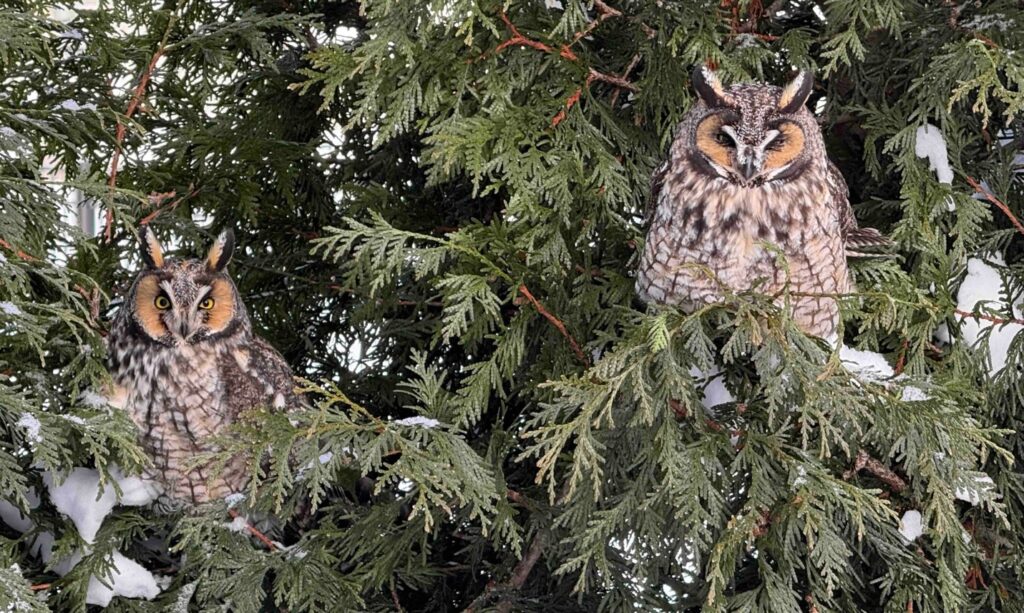
The pair of long eared owls roosting in our evergreen trees. We believe the owl on the left is a female and the owl on the right is a male.
A quick Google image search (confirmed by the Audubon website) quickly helped us identify our pair as long eared owls (asio otus). Furthermore, we appeared to have a male and female that I named Arthur and Guinevere after the figures in the famed King Arthur legends.
According to Audubon.org, the long eared owl is a medium-sized owl species that is relatively plentiful but rare to see in the central Ohio area. Long eared owls have relatively large wingspans for their body size, sometimes reaching 1 meter. Long eared owls have excellent camouflage with their speckled buff and dark brown feather patterns and elongated orange facial discs around their eyes.
Facts About Long Eared Owls
Once we identified our guests as long eared owls, I started researching the species. Some interesting facts I learned include:
- The prominent ear-like features that long eared owls are named for are not actually their ears: they are feathers called “ear tufts.” The ear tufts can stand straight up when alert or lay down flat, usually during flight.
- The owls’ ears are special openings called “ear slits” that are located in their facial discs. The ear slits are asymmetrical, with one located higher than the other. This placement allows the owls to hear sounds above and below them at the same time.
- Long eared owls may migrate from areas further north than central Ohio’s latitude in winter but tend to return north for breeding season, which usually begins in March/April.
- Long eared owls can roost together in groups of two to more than a dozen in winter, which is not typical behavior for owls. They prefer dense evergreens that allow them to stay fairly hidden and very well camouflaged in the foliage and branches. They also tend to return to “favorite” roosts year after year.
- Long eared owls hunt meadow voles and other small prey that sometimes includes small birds. The owls’ soft downy wing feathers allow them to fly silently just above the ground until the prey is located through sight or sound. Prey are usually swallowed whole and undigestible parts are excreted in pellets.
- When long eared owls sense danger, their ear tufts stand straight up and their bodies become very tall and narrow. This response enhances their camouflage in dense foliage by making them look more like dead tree branches.
Observing the Owls
The owls’ daily behavior was so interesting to watch. After it became clear the owls would be in our yard for at least a few days, we set up a webcam in our kitchen window to observe their comings and goings.
Evenings shortly after sunset, Arthur would either fly to another tree in our yard to preen and observe his surroundings for a few minutes, head swiveling all around, or he would immediately fly north out of our subdivision, probably to find more undeveloped land for hunting. Guinevere would follow him within a few minutes.
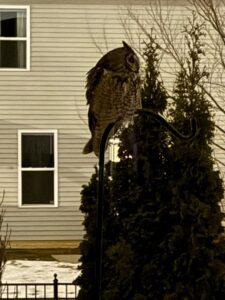
Arthur surveys his surroundings from our shepherd’s hook shortly after sundown, before leaving to hunt.
The owls departed later as the days slowly got longer. We started keeping our indoor and outdoor lights off for about an hour starting at sunset so the birds would not be as affected by our artificial light pollution.
Our webcam showed them returning in the mornings before sunrise, usually one after the other. A few mornings, only one owl returned. Arthur was more comfortable roosting on an open branch. Guinevere tended to stay more hidden.
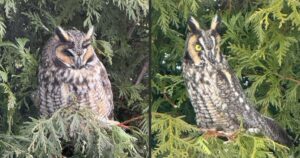
The owls remained generally still throughout the day, although they were alert to their surroundings. They would often open their eyes all the way and turn their heads to observe us moving around in the house. One morning, several crows flew into our yard, cawing and circling. Arthur sat up very straight and narrow and was on his guard until the crows left and he relaxed again.
Caption: An interesting comparison of two images showing Arthur relaxed (left) and on high alert (right) after the crows arrived. His alert form is visibly more upright and narrow and almost makes him look like a completely different owl!
An interesting comparison of two images showing Arthur relaxed (left) and on high alert (right) after the crows arrived. His alert form is visibly more upright and narrow and almost makes him look like a completely different owl!
Humans Can Be Better Wildlife Stewards
I’ve always loved wildlife and it was so fascinating to watch Arthur and Guinevere for a few weeks. They made me more aware of human expansion into the already shrinking wildlife habitats around us. They made me more thoughtful about how I can do small things to help local wildlife, such as keeping outside lights off.
I asked Zachary Hagen, graduate student at Bowling Green State University with a research focus on conservation behavior, for his thoughts on how we can be better stewards for birds of prey when we see them in our Ohio backyards. He told me that environmental changes can impact the types of prey that are available. He also mentioned that pollution and pesticides can have a compounding effect in the food chain. “When a prey animal eats prey, if that prey animal has consumed pollutants, it is then concentrated towards birds higher up in the food chain,” Hagen shared. “A good step to stop this is the “Leave No Trace” with your trash… and to reduce the use of unnecessary pesticides in gardens.”
I also asked Hagen about the effects of climate change on bird migration patterns. He told me: “The timing of migration can be affected by climate change, as the rising temperatures affect the availability of food along [the] journey. In addition, the shift in weather patterns has been observed to change flight paths as winds change.”
A Lasting Impression
As I write this, we haven’t seen either owl for over a week. I’m pretty sure they’ve moved on to wherever they intend to spend the breeding season. We do miss seeing our feathered guests when we look out our kitchen window.
I am honored Arthur and Guinevere chose our yard to be a safe space for as long as they needed one. Their story has brought so much joy to our family and friends who have been following it. I hope they have a safe journey and that we see them again next winter!
[Resources: Audubon.org, Wikipedia, AllAboutBirds.org, Mass.gov]